
Life in the Soviet Union and East Germany: Prices and Daily Life
October 16, 2026
Wages, bread, rent, television sets and cars: the numbers from everyday life in the Soviet Union and East Germany look surprising next to Western ones. Bread cost almost the same for twenty years, rent was a small slice of pay and a car took years to get. Below are the real numbers from our game data for 1970, 1980 and 1990, and the one caveat you have to keep in mind while reading them.
The caveat: regulated prices
Both countries set prices by decision, not by supply and demand. That makes the price tags very stable, but it also means a low price doesn’t tell you whether something was in the shop. The data notes say it plainly: Soviet regulated prices did not show shortages, and in East Germany many goods, such as cars and flats, had waiting lists of years. A bread price of 0.16 rubles is a fact about the price. It is not a fact about the queue.
Keep this in mind for everything below: the tables show what an item cost, not how easy it was to get.
Soviet Union: wages and prices
All figures are in rubles of the year and come from the “anchor year” data points. The Soviet figures are in rubles after the 1961 reform, which swapped ten old rubles for one new one.
| Year | Monthly wage | Bread (loaf) | Milk (1 litre) | Petrol (1 litre) | Cinema | Rent (month) | TV set | Car | Jeans |
|---|---|---|---|---|---|---|---|---|---|
| 1970 | 122 | 0.16 | 0.28 | 0.08 | 0.25 | 12 | 300 | 5,500 | 150 |
| 1980 | 168 | 0.16 | 0.28 | 0.20 | 0.30 | 14 | 650 | 7,500 | 200 |
| 1990 | 303 | 0.20 | 0.35 | 0.40 | 0.50 | 18 | 800 | 11,000 | 250 |
East Germany: wages and prices
East Germany used its own East mark (symbol M). Prices were just as stable as in the Soviet Union, and in the case of bread, milk and petrol they did not change at all from 1970 to 1990.
| Year | Monthly wage | Bread (loaf) | Milk (1 litre) | Petrol (1 litre) | Cinema | Rent (month) | TV set | Car | Jeans |
|---|---|---|---|---|---|---|---|---|---|
| 1970 | 755 | 0.52 | 0.68 | 1.50 | 1.80 | 42 | 1,200 | 8,500 | 40 |
| 1980 | 1,030 | 0.52 | 0.68 | 1.50 | 2.50 | 60 | 1,300 | 9,500 | 50 |
| 1990 | 1,300 | 0.52 | 0.68 | 1.50 | 3.00 | 75 | 1,150 | 12,000 | 55 |
What a month’s pay really covered
The raw tables are in different currencies, so the useful comparison is the ratio: how much of a month’s wage each thing took.
| Soviet Union, 1970 | Soviet Union, 1980 | Soviet Union, 1990 | East Germany, 1970 | East Germany, 1980 | East Germany, 1990 | |
|---|---|---|---|---|---|---|
| Loaves of bread per wage | 762 | 1,050 | 1,515 | 1,452 | 1,981 | 2,500 |
| Rent, share of wage | 10 percent | 8 percent | 6 percent | 6 percent | 6 percent | 6 percent |
| TV, months of pay | 2.5 | 3.9 | 2.6 | 1.6 | 1.3 | 0.9 |
| Car, months of pay | 45 | 45 | 36 | 11 | 9 | 9 |
A few things jump out. Rent was a small slice of income in both countries, a good deal smaller than the 19 to 26 percent in the American data for the same period. Cars were the opposite: about 45 months of pay in the USSR through 1980 and about nine to eleven in East Germany, against four to five in the US data. A TV was a real purchase in the Soviet table (two to four months of pay) and about a month of pay or less in the East German one.
Jeans tell their own story. In the Soviet data a pair is 1.2 months of pay in 1970 and 1980, while in the East German data a pair is a few percent of a monthly wage. The data does not explain the gap. It does fit the East German news line for 1979: “shops selling goods for Western currency tempt customers with chocolate and jeans.”
The waiting list that numbers don’t show
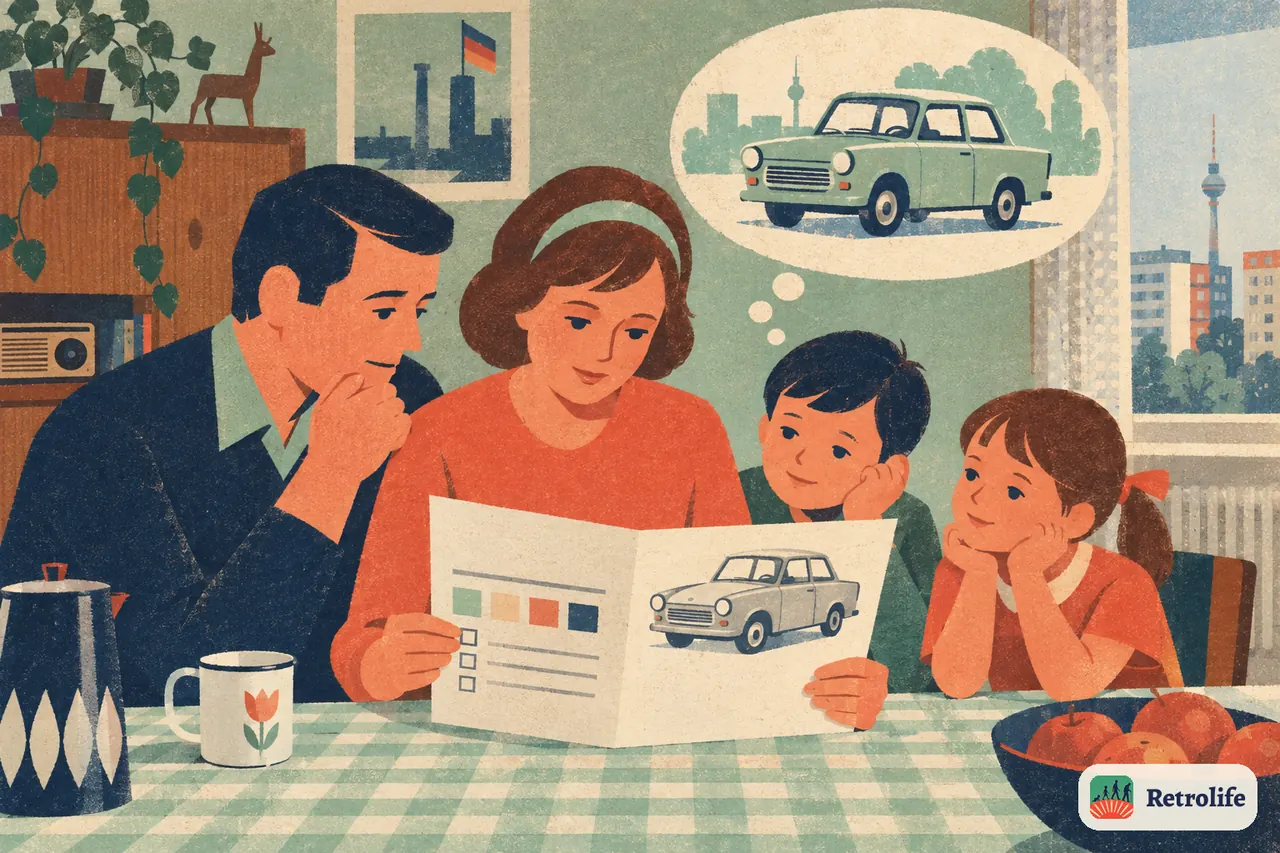
The cars in the tables are priced, but you could not simply walk in and pay. The news line for East Germany in 1970 says it directly: “Ordering a family car means waiting ten years or more.” For the Soviet Union, the 1981 line is almost the same sentence: “The long wait for a private car is still a family’s biggest dream.” If you want to understand what a car meant to a family, those two lines will tell you more than the price column.
Everyday life had its own rhythm too. In the Soviet news lines, a five-day working week with two days off arrives in factories and offices in 1967, and by 1983 city families grow potatoes and tomatoes on small dacha plots at weekends. In East Germany the 1971 line promises a flat of their own to every family, 1972 opens travel to neighboring Poland and Czechoslovakia without a visa, and 1975 has garden plots and weekend cottages as the favorite escape from city flats.
Living standards and the late 80s
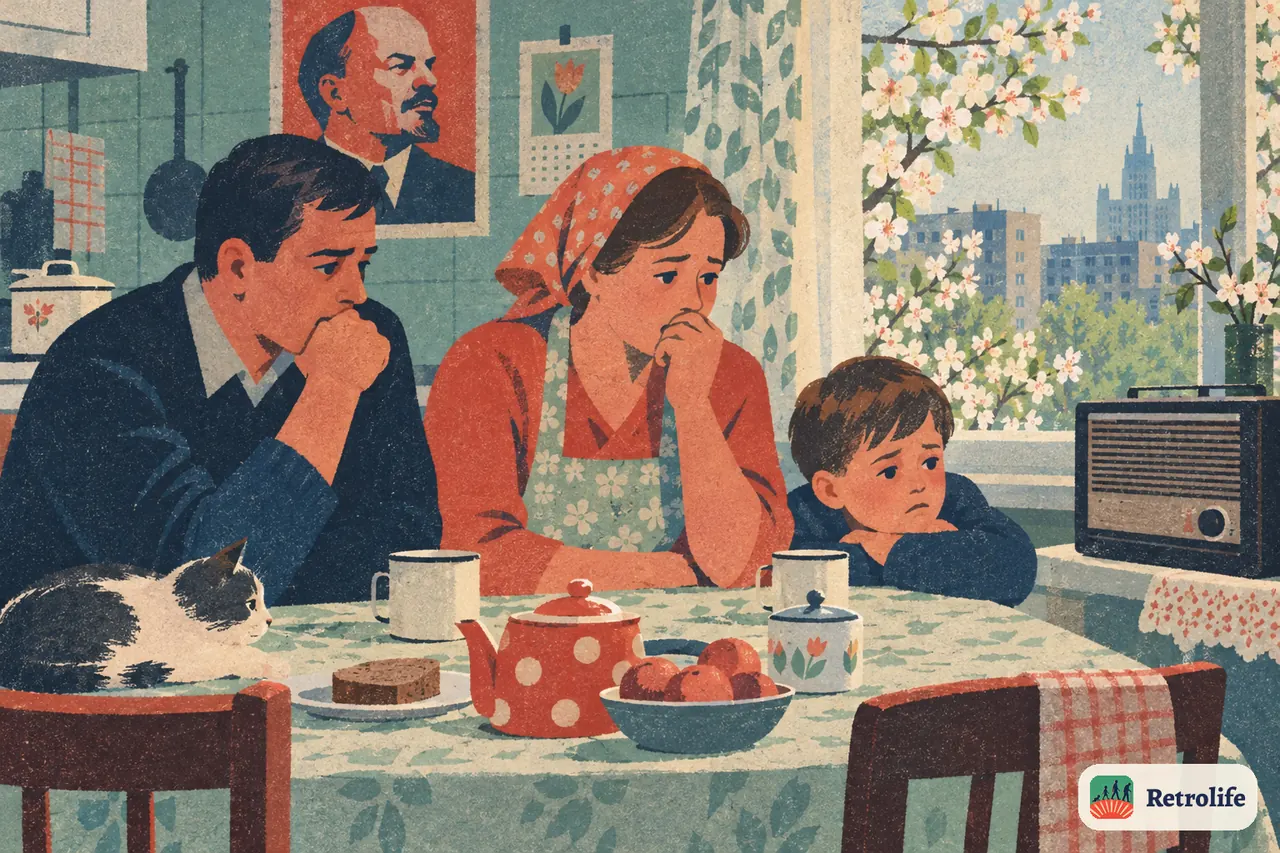
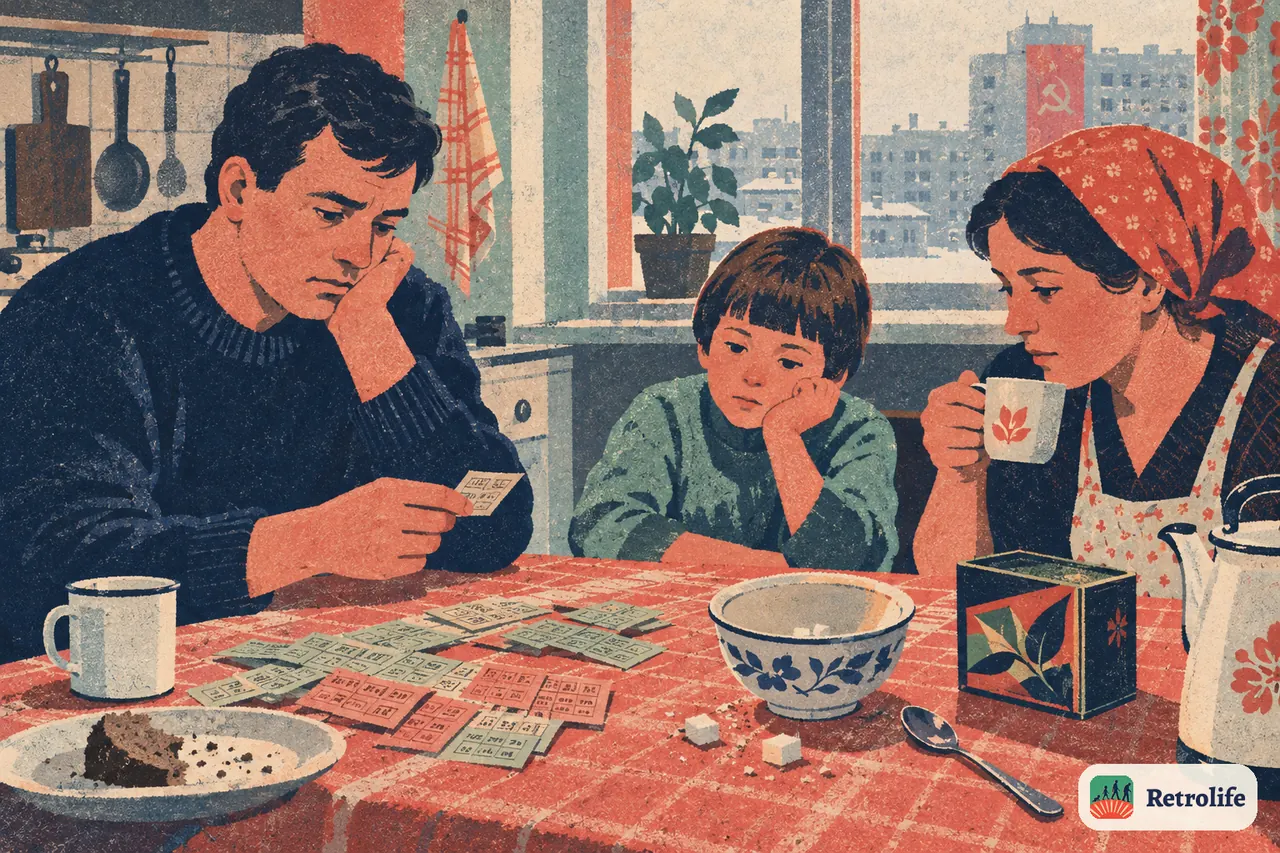
Both economies shifted at the end of the period. In 1985 the Soviet line has alcohol sales restricted and fewer bottles on the shelves. In 1987 the first cooperative cafes and workshops open, “and people queue to try them.” In 1989 shops run short of tea, soap and sugar, and ration coupons appear.
East Germany’s late-80s line reads differently: in 1986, “almost every household owns a television and a refrigerator, but cars and telephones remain scarce.” It is a compact picture of the period in our data: basics cheap and everywhere, the big purchases scarce. Life expectancy at birth in the data was 69.1 years for men and 74.2 for women in East Germany in 1970 (63.0 and 73.4 in the Soviet Union), and reached 69.9 and 76.3 in East Germany in 1990 (63.8 and 74.3 in the Soviet Union).
For what came next in both countries, see 90s nostalgia, year by year.
You are twelve in 1979, and your uncle has just come back from the shop that only takes Western currency with a bar of chocolate and a pair of jeans for you. The jeans are too big. You will wear them until they fall apart.
How this works in Retrolife
In Retrolife you can be born in East Germany or the Soviet Union and live the way these tables describe: low, steady prices, a long wait for the things that matter, and news that reaches you at your age. The prices, wages and waiting-list lines here are the same ones the game uses. If you’d like to see another year of your own, our year-of-birth guide lets you look it up, and our postcards let you send a piece of it to someone.
FAQ
How much did a month's pay buy in the Soviet Union?
In our data the average monthly wage was 122 rubles in 1970 and 168 in 1980. A loaf of bread cost 0.16 rubles, so a month's pay covered about 760 loaves in 1970 and about 1,050 in 1980.
Were prices really that low in East Germany?
On paper, yes. Bread stayed at 0.52 marks and rent was around 40 to 75 marks across the period in the data. But prices were set by the state, and waiting lists for cars and flats don't show up in the numbers.
Do these prices show shortages and queues?
No. Prices in both countries were regulated, so a low price tag says nothing about whether the item was actually on the shelf or how long you waited for it.